Is it time to go solo?
It is the AI wave, and it is a great time to build solo. Now, if you have good design judgment, you can build complex systems by yourself - because the main part of building complex systems was never the design. The design is just the initial phase.
Before we get into that, let’s talk about the software lifecycle. A standard one looks like this: you design a system, you get approval, you implement it, you push it to production safely, you monitor the changes, you roll in traffic gradually, and you make sure the system works - the right amount of monitoring, traffic alerts, paging, and escalation mechanisms to catch things when they go wrong and fix them immediately.
Historically, the most time has gone into implementation, and that work was distributed across many people in a large team. And there is a hierarchy, because humans work well in hierarchy - so naturally that flowed into the software development lifecycle. A senior developer looks into the work of n junior developers, a senior manager looks into the work of n senior developers, and so on, until you reach the CEO. This scaled, and it worked well for years.
Where does the time actually go across those phases? There is no industry-wide time study, so treat this as illustrative rather than measured - but anyone who has shipped in a big tech team will recognize the shape:
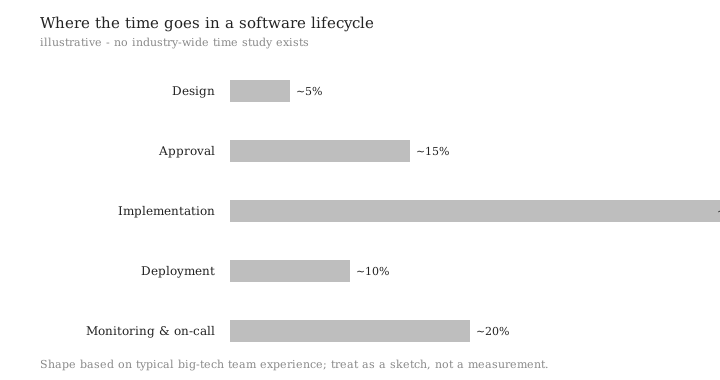
Implementation dominates - and implementation is exactly the part agents just compressed.
One fundamental thing changed in the last two years: the entry of agents. With agents, you do not need all those small teams to create the work. Once the design is really good, a senior developer can spawn multiple agents, and each agent can act like a mid-level engineer and get things done. AI is essentially free - more on that in a future post.
That really changes the economics. An SD in the US makes roughly $250k to $350k in total compensation at a big tech firm, cash plus stock. A team of ten costs about $2.5 million a year. Realistically - because review is still a huge bottleneck, also a future post - two people can run a team that used to need ten. Can those two split that money between themselves? Having worked in this industry, I would definitely say yes. It already happens, subconsciously or in an obfuscated way: some A-players lead the team and do most of the work while getting the least reward relative to the outcome they drive. AI leverage is making that gap wider every quarter.
So if a few people can get most of the work done, why don’t companies just cut teams? Because it goes against the whole structure of big tech. And this is not a single-variable system - it is a multi-dimensional problem where everyone’s incentive has to align for anything to happen. Your manager gets promoted when he promotes n people under him. For any one promotion, he needs data - a packet reviewed by a loop of people at the level the company recommends. It ensures promotions are decided objectively, and it is fair. But notice the shape: the developer is incentivized to do the work that helps the review committee approve his promotion, and the manager is incentivized to promote n people. The manager was never incentivized by the amount of work delivered; the work just had to exist so people could be promoted, and promoting people became the proxy for whether a manager had delivered a lot. This is incentive structures at work - that deserves its own post.
Now that a few people can do the work of many, this equation breaks. The manager no longer has ten people to promote. There is a change coming in how tech jobs are structured, because the old model no longer fits - the present model is the one with agents.
And the people doing the work of five to ten will notice: if I can get this much done inside a company, I can get way more done outside. It is more permissionless, faster to iterate, faster to move. Remove the corporate review process and the store-down process, and you are just a person with a laptop - and if you know your stuff, you can get a hell of a lot done. The equation is starting to shift to where you can try a bunch of things and make way more than a big tech salary.
If we are being honest, no one wants a job. A job just pays well - well enough to keep the delta small between what the job pays and what a person could realistically achieve with the same effort, the same pain, and the same risk tolerance. Everyone can chase an outcome on their own; that game just has a different set of rules - more variables, more ambiguity, and a factor of luck. But if you stick long enough, you increase your chance of success. The job game is the other one: predictable income, lower ambiguity, show up consistently, get evaluated at some frequency the company decides. Which game suits you depends on your combination of attributes. But in a world where a few people can get a lot of shit done, more and more people will definitely start going solo.